Showing posts with label Religious Sites. Show all posts

Nov 5, 2014

Rome for free


Rome is a lovely city on many of our travel bucket lists, and for good reason. The Vatican! The Trevi Fountain! the Colosseum! the Roman Forum! Gorgonzola cream sauce!

But whatever you're traveling for, you'll find that Rome is an expensive city. First, the hotels are ridiculously priced, especially during tourist season. Then you'll find yourself paying for the tickets to see inside many of the famous monuments and museums (even more if you want to skip the lines), and then there's all the craft beer bars if you travel with a beer nerd.

Fortunately, there are also quite a few things to do that are free in Rome, and a lot of things that cost money to go into, but you can still enjoy very much from outside for nothing.

Churches

The churches are free, including St Peter's Basilica in the Vatican. There was quite the line to go in, but it moved quickly.


Arcibasilica Papale di San Giovanni in Laterano AKA St. John Lateran's Basilica


Basilica of Saint Mary Major

The Pantheon


Two we didn't get a chance to see, but you might want to check out, too:
The Museum of Purgatory exhibit in the Chiesa del Sacro Cuore del Suffragio
St Ignatius with an optical illusion of a dome painted onto its flat ceiling.

Colosseum, Forum and Palatine hill

You can also walk around these famous relics of eras past, although you can't actually go in them for free. However, they're impressive from the outside and since the Forum is really a collection of ruins and columns rather than a single structure it's best viewed from afar, and there are many places around the edge that have you looking down into and out across the ruins. 

This view will cost you nothing
They are all especially beautiful at night.


Some other things to do:

The Campidoglio, the square from where I took the above photo of the Forum, is an interesting place to stop by. On one of the seven hills of Rome, the square is suurounded by columned musuams, with an ornate tiled pattern in the pavement. You can even get a peek at a replica of Michelangelo's David.


Altare della Patria (Altar of the Fatherland),  - a great, monstrous monument to Italy's WWI troops and King Victor Emmanuel II. While the Museum inside costs 5euro, the ostentation statue covered monument itself is quite interesting to see in it's own right.


Borghese Gardens -  the gardens surrounding the famous Galleria Borghese are a public space. The grounds include numerous gardens, including so called "secret gardens" specially designs for their seclusion and replicas of ancient temples.

Trevi Fountain - Which was undergoing construction while we were there.

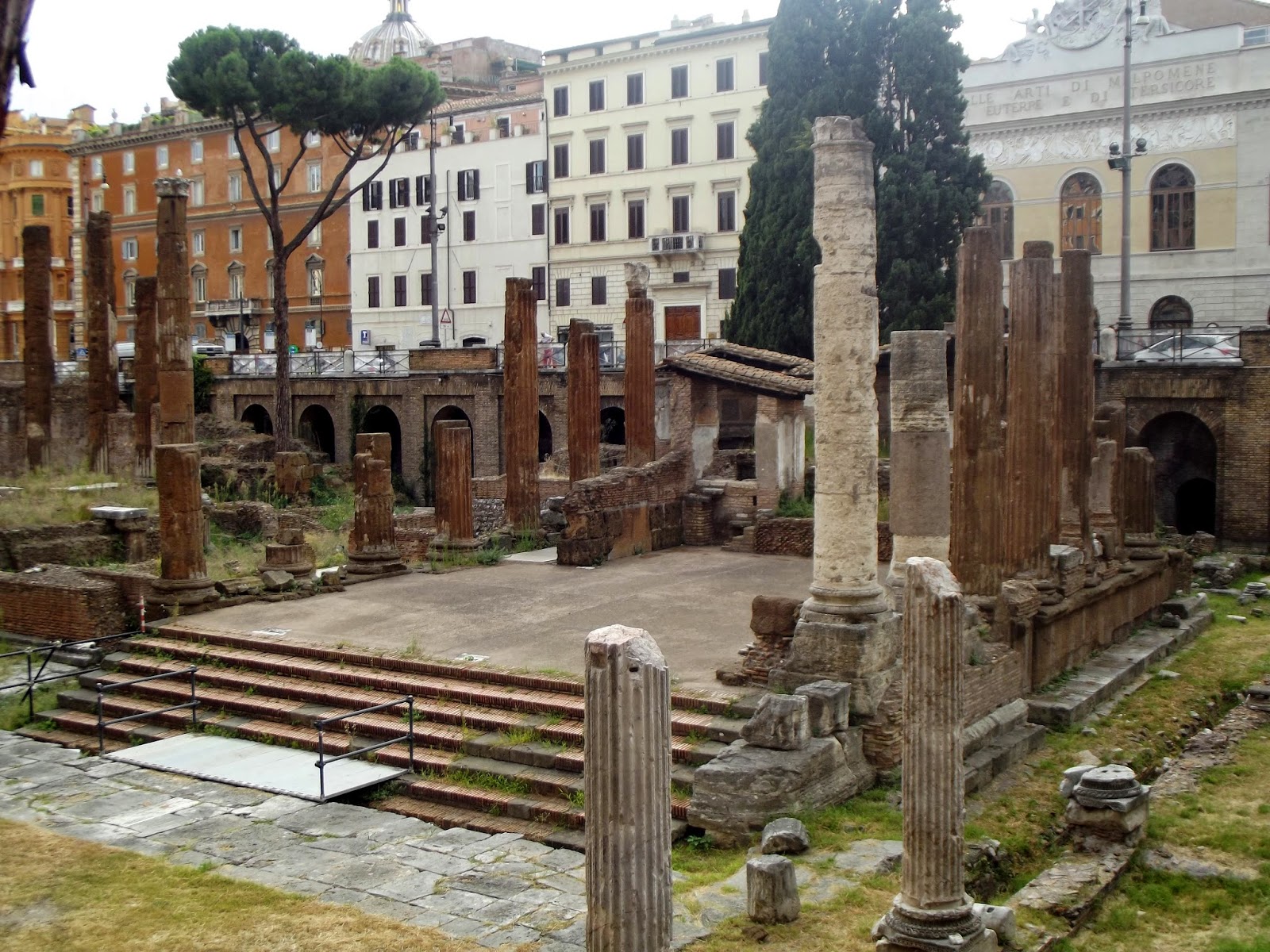
Torre Argentina Cat sanctuary - A small cat shelter open to the public hidden next to Roman ruins where cats bask in the sun. I wrote about it previously here (with more kitty photos).



You can also while away some time browsing the late night flea market at St Angelo Castillo, where there were also open air movies playing when we visited. There is also an interesting pop up style row of bars along the river that's an interesting area to walk through, with live music, games and lots and lots of giant mojitos.


This post also appeared in heylovedesigns.com's Friday Favorites Link Up.

Oct 30, 2014

Sedlec Ossuary

Sedlec Ossuary is also known as All Saints Church in Kutna Hora and "that bone church near Prague". Located in a suburb of Kutna Hora about an hours train ride from Prague, the ossuary often pops up in lists and slide shows on unusual churches, creepy destinations thing to see in the Czech Republic. 


First impressions of it were that was very small. I had imagined it as some grand, Gothic cathedral with spiky bits and flying buttresses and moody organ music. There was a small cemetery around it, with both old a new grave markers. Rather than being looked after by a grim and scowling warden, the two ladies working inside were incredibly cheerful.


As soon as you go in, you're greeted by grinning skulls and boney decor. It has a bit of an amateur haunted house feel to it, except these bones aren't made of plastic and plaster.


The Schwarzenberg Coat of Arms, the family who once owned the land the ossuary is located on:


As soon as you go in, you're greeted by grinning skulls and boney decor. It has a bit of an amateur haunted house feel to it, except these bones aren't made of plastic and plaster.


The message behind it is supposed to be that in death we are all equals, and that the femur of a lord might find itself next to the jaw bone of a pauper.


I wrote a  little more in an earlier post on the whole day trip, but a Czech king sent a priest to Jerusalem around 1278. He returned with soil from Golgotha (also called Calvary, where according to the Christian Gospels is where Jesus was crucified), which he spread over the cemetery, making it Holy Land. After that, people from all over Europe wanted to be buried there and it filled up quickly.


The Plague saw more burials in a short period of time and more came after the Hussite wars. The wars  also caused the destruction of the cathedral, monastery and cemetery Church. During the rebuilding, the land for the cemetery reduced, and the bone left outside of the graveyard were dug up and moved inside the ossuary.


At the end of the 15th Century, according to legend, a half blind monk's sight returned to him after he created the bone and skull pyramids in the ossuary today. The macabre decor seems to have expanded through the following years, but it was Jan Blažej Santini-Aichel who really embraced the aesthetic in the early 18th Century and designed the chandeliers, garlands and added the cherubs.


 A wood carver named František Rint finished ordering the remainin bones in the 1870, and left his signature on the wall. In bones, of course.


Some parts are macabrely humorous, like something by Tim Burton. The original coat of arms has a raven pecking at the head of a Turk with an distinct hair-do, and I'm not sure the iconography makes the jump into bone well. 

Wasn't this guy in the Corpse Bride?
Surprisingly, once you get past the creepiness of it all, the ossuary is quite peaceful. Most of it is slightly underground so there's no sounds of traffic or kids playing. The walk from the train station to the ossuary is down a road with many tourist cafes and restaurants, and although the weather was a bit questionable and grey at times, it was overall cheery. 

Aug 7, 2014

A Week in Prague: Day 3

Since we were staying a whole week in Prague, we thought it might be nice to take a day trip away from the city. We'd heard about a mysterious 'bone church' not far from Prague, and took the opportunity to investigate.

We bought our train tickets at the main station, Hlavní Nádraží, where the teller very helpfully wrote down the stations where we would have to switch and the times of the next train to catch for us.


Kutna Hora 

Instead of seeing the osuary right away, we first visited the main part of Kutna Hora, where we got some lunch and walked to St Barbara's Cathedral.


Looking out over the view, we noticed a mysterious face in the forest gazing back at us. I couldn't figure out who he was, but I did snap a photo of the plaque nearby, to translate later.


Which says something like (italics mine):

Across the valley Vrhlice in rock relief
Jaroslav Vrchlický (Jaroslav Vrchlický was a Czech poet with a big mustache)
Left: Hradek, sv. Jacob
Italian Court A Mother of God (I assume this refers to a statue to the left)Vpozadi: top Kaňkovská, Sedlec
New Court, and Les Chateau Kačina
Right: Church of the Holy Trinity

The original orientation board given by the Czechoslovakian Tourist District Club was made ​​in the foundry of Antonio Smrkovsky in Kutna Hora and stolen in 2007. The new board was made ​​at the expense of the town of Kutna Hora in 2008.
Below us, we could look into the back yards of some of the houses. The main reason I chose my current camera over comparable models is the zoom capabilities, which are quite often used to take photos of fluffy beasties from afar:


While we did not go in St Barbara's, it is a beautiful little Gothic cathedral you reach by walking along a statue studded promenade with amazing views. Although it was not the most interesting part of the day's trip, it was nice to be able to look around at the rest of what the town had to offer.

The Sedlec Ossuary

After circling around St Barbara's, we walked back to the station, and took the little regional train to Sedlec to see the famous Ossuary.

The first thing that surprised me about the Osuuary was how small it was. From the photos I'd seen, I was expecting something far grander and melodramatic. Instead, it looked more like a small chapel with some gravestone of various ages around it. The other thing that surprised me was how how happy and friendly the two women working inside were! They handed out laminated pages of information in your requested language, including to man overjoyed at finding they had historical information in Portuguese. Overall a very upbeat introduction to the skulls and bones just a few meters away.

According to the information handed to us, the Czech king sent an Abbot to Jerusalem around 1278. The Abbot returned with soil from Golgotha (also called Calvary, where according to the Christian Gospels is where Jesus was crucified), which he spread over the cemetery. The soil from Jerusalem made the graveyard Holy Land, and people from all over Europe requested to be buried there. As you can imagine, it got quiet crowded.

Add to that the Plague of the 14th century, which led to 30,000 people buried there. More came after the Hussite wars, which also led to the destruction of the cathedral, monastery and cemetery Church. During the rebuilding, the area designated for burials was reduced, and the bone left outside of the area were dug up and moved inside the ossuary.

At the end of the 15th Century, according to legend, a half blind monk's sight returned to him after he created the bone and skull pyramids in the ossuary today. The macabre decor seems to have expanded through the following years, but it was Jan Blažej Santini-Aichel who really embraced the aesthetic in the early 18th Century and designed the chandeliers, garlands and added the cherubs.


I'm planning on doing a post solely on the ossuary with more photos - maybe for Halloween? 


 After looking around, we walked to main station and made our way back to Prague.

We grabbed some coffees in a small place called Tricafe, where I overheard an English lesson. I kept wanting to join in when the teacher asked his students where their last holiday was to, where they were from, etc.! 

There was also some great record art on walls, with cut outs forming silhouettes of musicians and dancers, famous people with their signatures, and abstract designs. I wish I'd taken more photos of them! Here's a snapshot by Alina Nanu, on instagram, via Iconosquare.com


Lehka Hlava turned out to be worth the wait. The staff seemed a little distracted, but we had a really great meal for about 21.50€: two ginger lemonaids, an appitizer, and two entrees. I got the red curry, which is one of my favorite dishes, and my husband, usually a meat eater, got a red beet burger.


We walked along the Vltava river before heading back to the western side. Such a beautiful sunset!


Jul 30, 2014

A Week in Prague: Day 2

We started the day bright and early (more 7:30 construction) and started our walk towards the castle, stopping for lunch at Kafe U Zelenych Kamen. Since nearly everything there had meat in it, I ordered the cheese platter, which came with olives and capers... I thought there would be a nice selection of stuff to nibble on.

I'd heard of stinky cheese before, but never believed cheese could smell and taste so gym-socks-like and still be considered edible! Not that it was the fault of the Kafe U Zelenych Kamen, I'd ordered the cheese platter and that's certainly what I got.

Some cheese deserves a written warning. Or maybe even a waiver to sign.

There arebgreat views from the hills surrounding Prague, photos of which will appear in more than one blog post. Even if you aren't interested in the castle or weapon grade cheese, I'd recommend climbing it just for the views alone.

Prague castle is not in fact a castle. If you've read my blog before you'll know I love castles, and I mean the old, stone citadel/fortress/storm the gate/man the ramparts kind of castle. Because I am a nerd. (Also, my Grandparents live on the Welsh border, and the English knew how to build castles.)

And Prague Castle is not one of these. There is a cathedral, St Vitus that is part of the iconic skyline of Prague, and a few palaces and government buildings that are all quite grand, but those windows are entirely too impractical in event of a siege, or a small child with a rock.


We stopped by the ticket office and bought two ticket for the shorter tour, and a 50Czk (about 2 euro) permit so I could take photos.

We did get to see the changing of the guard, in the rain.


Then it was on to St Vitus's.


Just inside the cathedral were a group of children singing, very beautifully in (I think) Latin, it was a wonderful introduction to the cathedral, and though I know very little about ecclesiastical music, it was exactly what I think should be sung in a Gothic cathedral.

Just after you go through the ticket check, to the left, there is a beautiful stained glass window by Alphonse Mucha stained glass. Mucha is one of my favorite artists, and you've probably seen his work before:


via Wikicommons
I know I prefer Art Nouveau over Art Deco, although I couldn't quite tell you what the difference between them is.  I think Art Nouveau tends to be more romantic and fluid, while art deco is a little more robust and industrial. Or something.

Anyway, I'll feature more close ups in another post. It really is a very beautiful window, and the highlight of the cathedral.

Next we visited the Old Palace, which was far more functional rather than luxurious. It included one of the Defenestration of Prague windows (the 1618 one), and this interesting hall, New Land Rolls Room, :


In this hall, there was an employee sitting in the corner yelling "no photos!" since it was possible to buy a photo-taking permit, I assumed she meant no photos regardless of permit, that this was a special off limits room. Fortunately, the man next to me took out his pass, a little piece of receipt paper and waved it at her across the room. This seemed to satisfy her, but she kept yelling until I did the same.  Being yelled at left a me with a bad taste, especially since it would have been easier, quieter and more enjoyable for all if she'd just checked our permits when we walked in the room.

But all was forgiven when we went on the final portion of the tour, where we found the weapons and armor collections (I'm nearly positive all are reproductions, but they still look pretty cool!)


In the basement of the building was an alchemist's lab exhibit:

We walked down from the castle in the rain, and decided we needed to warm up with coffee and crepes.


We crossed Charles bridge back to the east side of the river in the rain. Even then it was crowded and full of people selling paintings and other trinkets along the sides.


We'd heard good things about a restaurant named Lehka Hlava/Clear Head, and that it was so popular you'd need reservations. Since it was a rainy thursday, we thought we'd have no problem getting a table. Nope, it was that popular. We made reservations for the next night (spoiler: it was amazing) and headed home for the night.

Author Info

Instagram