Showing posts with label Sightseeing. Show all posts

Nov 5, 2014

Rome for free


Rome is a lovely city on many of our travel bucket lists, and for good reason. The Vatican! The Trevi Fountain! the Colosseum! the Roman Forum! Gorgonzola cream sauce!

But whatever you're traveling for, you'll find that Rome is an expensive city. First, the hotels are ridiculously priced, especially during tourist season. Then you'll find yourself paying for the tickets to see inside many of the famous monuments and museums (even more if you want to skip the lines), and then there's all the craft beer bars if you travel with a beer nerd.

Fortunately, there are also quite a few things to do that are free in Rome, and a lot of things that cost money to go into, but you can still enjoy very much from outside for nothing.

Churches

The churches are free, including St Peter's Basilica in the Vatican. There was quite the line to go in, but it moved quickly.


Arcibasilica Papale di San Giovanni in Laterano AKA St. John Lateran's Basilica


Basilica of Saint Mary Major

The Pantheon


Two we didn't get a chance to see, but you might want to check out, too:
The Museum of Purgatory exhibit in the Chiesa del Sacro Cuore del Suffragio
St Ignatius with an optical illusion of a dome painted onto its flat ceiling.

Colosseum, Forum and Palatine hill

You can also walk around these famous relics of eras past, although you can't actually go in them for free. However, they're impressive from the outside and since the Forum is really a collection of ruins and columns rather than a single structure it's best viewed from afar, and there are many places around the edge that have you looking down into and out across the ruins. 

This view will cost you nothing
They are all especially beautiful at night.


Some other things to do:

The Campidoglio, the square from where I took the above photo of the Forum, is an interesting place to stop by. On one of the seven hills of Rome, the square is suurounded by columned musuams, with an ornate tiled pattern in the pavement. You can even get a peek at a replica of Michelangelo's David.


Altare della Patria (Altar of the Fatherland),  - a great, monstrous monument to Italy's WWI troops and King Victor Emmanuel II. While the Museum inside costs 5euro, the ostentation statue covered monument itself is quite interesting to see in it's own right.


Borghese Gardens -  the gardens surrounding the famous Galleria Borghese are a public space. The grounds include numerous gardens, including so called "secret gardens" specially designs for their seclusion and replicas of ancient temples.

Trevi Fountain - Which was undergoing construction while we were there.

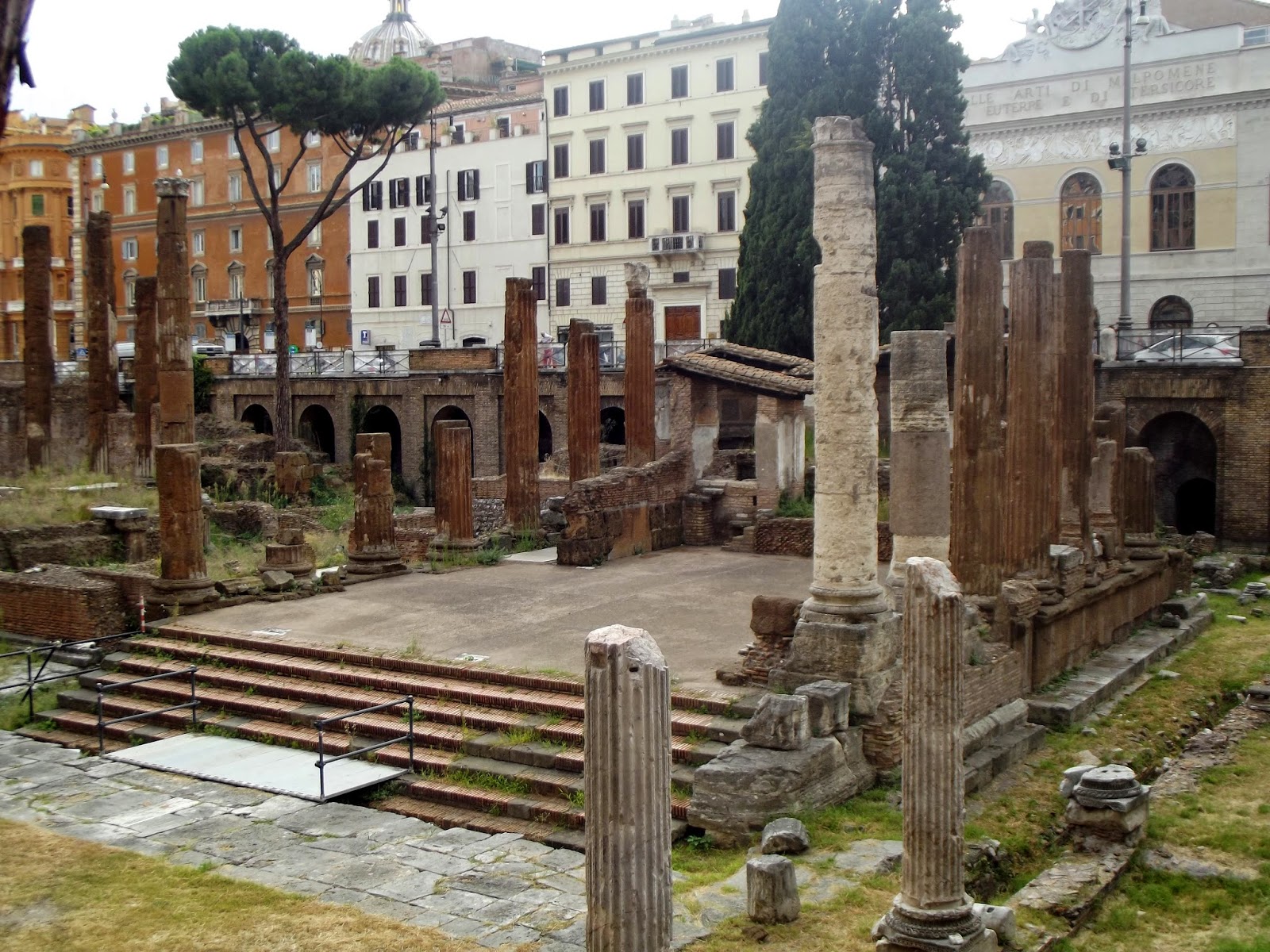
Torre Argentina Cat sanctuary - A small cat shelter open to the public hidden next to Roman ruins where cats bask in the sun. I wrote about it previously here (with more kitty photos).



You can also while away some time browsing the late night flea market at St Angelo Castillo, where there were also open air movies playing when we visited. There is also an interesting pop up style row of bars along the river that's an interesting area to walk through, with live music, games and lots and lots of giant mojitos.


This post also appeared in heylovedesigns.com's Friday Favorites Link Up.

Oct 30, 2014

Sedlec Ossuary

Sedlec Ossuary is also known as All Saints Church in Kutna Hora and "that bone church near Prague". Located in a suburb of Kutna Hora about an hours train ride from Prague, the ossuary often pops up in lists and slide shows on unusual churches, creepy destinations thing to see in the Czech Republic. 


First impressions of it were that was very small. I had imagined it as some grand, Gothic cathedral with spiky bits and flying buttresses and moody organ music. There was a small cemetery around it, with both old a new grave markers. Rather than being looked after by a grim and scowling warden, the two ladies working inside were incredibly cheerful.


As soon as you go in, you're greeted by grinning skulls and boney decor. It has a bit of an amateur haunted house feel to it, except these bones aren't made of plastic and plaster.


The Schwarzenberg Coat of Arms, the family who once owned the land the ossuary is located on:


As soon as you go in, you're greeted by grinning skulls and boney decor. It has a bit of an amateur haunted house feel to it, except these bones aren't made of plastic and plaster.


The message behind it is supposed to be that in death we are all equals, and that the femur of a lord might find itself next to the jaw bone of a pauper.


I wrote a  little more in an earlier post on the whole day trip, but a Czech king sent a priest to Jerusalem around 1278. He returned with soil from Golgotha (also called Calvary, where according to the Christian Gospels is where Jesus was crucified), which he spread over the cemetery, making it Holy Land. After that, people from all over Europe wanted to be buried there and it filled up quickly.


The Plague saw more burials in a short period of time and more came after the Hussite wars. The wars  also caused the destruction of the cathedral, monastery and cemetery Church. During the rebuilding, the land for the cemetery reduced, and the bone left outside of the graveyard were dug up and moved inside the ossuary.


At the end of the 15th Century, according to legend, a half blind monk's sight returned to him after he created the bone and skull pyramids in the ossuary today. The macabre decor seems to have expanded through the following years, but it was Jan Blažej Santini-Aichel who really embraced the aesthetic in the early 18th Century and designed the chandeliers, garlands and added the cherubs.


 A wood carver named František Rint finished ordering the remainin bones in the 1870, and left his signature on the wall. In bones, of course.


Some parts are macabrely humorous, like something by Tim Burton. The original coat of arms has a raven pecking at the head of a Turk with an distinct hair-do, and I'm not sure the iconography makes the jump into bone well. 

Wasn't this guy in the Corpse Bride?
Surprisingly, once you get past the creepiness of it all, the ossuary is quite peaceful. Most of it is slightly underground so there's no sounds of traffic or kids playing. The walk from the train station to the ossuary is down a road with many tourist cafes and restaurants, and although the weather was a bit questionable and grey at times, it was overall cheery. 

Sep 4, 2014

Bracciano Lake and the Orsini-Odescaldi Castle

Since we were in Rome for quite a few days, we thought it might be nice to get out of the city for a day, especially to beat the weekend crowds. At first, we were thinking about going to Pompeii, but after looking at the prices and times of the trains from Rome to Naples, we moved on. Our next choice was the beach, but after reading about how crowded and dirty the beaches near Rome to be, I kept looking for alternatives. Fortunately, I found an article by Amanda Ruggeri on RevealedRome.com on the best lakes near Rome. I thought a lake could be a pretty good alternative to the beach, and when I saw Bracciano lake had a castle, I was sold.


We took the metro to the Valle Aurelia Station, where at the far end of the platform there was a man making strange breathing noises, with a sheet of foil and a straw. Our substance addled fellow traveler took a seat in front of us, and ran up and down the steps at nearly every station until finally getting off the train. So that was a memorable start.

After a long ride we got off at tiny station. If we hadn't seen the castle from the train as we arrived, we might have thought we were in the wrong place.

 Eventually after a bit of walking around, we found the main square.

We walked up and down the streets looking for somewhere to eat. Eventually we sat down at a little restarant down a side street with a sign in the shape of a snail. Despite being chosen more or less at random, it ended up being quite memorable, as the waiter made fun of my husband's attempts at Italian, and I had Fagottini, a little purse of pasta with pear stuffed inside, in creamy cheese sauce.


After lunch, it was getting quite hot so we decided to cool off before visiting the castle with some gelato, which was quite good (although the overbearing techno we had to listen to while eating it dampened my enthusiasm) but it was the little desserts that really stole my attention.


Row after row of delicate, colorful pastries, like jewels on velvet pillows in a high street window.


Next it was onto the Castello Odescalichi! 


When we bought our tickets we were offered a map/guide in German (we went with the English one). The guide contained the history of the castle and a description of the rooms, written in a style both pretentious and pompous:
"The Orsini-Odescaldi Castle in Bracciano could be considered a palimpsest of history and architecture, a sort of living organism bearing witness to the way it has been repeatendly transformed...
Any tour of the Castle should start when it appears in all its splendour in the distance as you drive up from the lake..."

I bet the author wears frilly shirts.


Photos were forbidden, so I have no idea where these pictures came from.

The castle was first build around the year 1200 by the prefects of Vico, but then was acquired by the Orsini family. All over the castle are statues and images of bears, and I felt pretty clever when I made the connection between Orsini and Ursa (as in Ursa Major, the Great Bear). Ok, now that I look at them Orsini and Ursa aren't that close, are they? Damn. No wait, the Italian word for bear is Orsi. I'm clever again.


Anyway, in the late 1400s another stage of the building took place, where the guide drops a lot of names of people you're supposed to be impressed with. Bracciano eventually became a duchy, and the first Duke Orsini, Paolo married a Medici, Isabella.


The Medici's are always fun. When you reach the room called Isabella's bedroom, the guide tells you:
It is also known as "Isabella's Room" because legend has it that, after a night of lovemaking, Isabella de' Medici used to push her lovers down a blade-lined well.
The guide goes to to dispel these rumours, and tells us that Isabella and the duke were actually quite happy with one another, he once writing to her "I adore you, my beauty...and believe me when I say that when I die people will not remember me for my children, my rank, my friends, the women in my life, or anything else, they will remember that I adored you."

Relationship Tip: when professing your love and devotion to your wife, don't mention your other women.


Duke Paolo also decided to turn the fortress into a palace, where more name drop worthy Italian artists came to work. Eventually the Orsini had to sell their castle and it was bought by the present owners, the Odescalichi,.


The information provided in the map and the panels in each room very much implied that the original room had been preserved or recreated, when really the room was just a place to display part of a collection. For example, the rooms were given names based on the furniture housed in the room, not the rooms historical function, so you had to walk through bedrooms to get to the armory.

Apparently, you can avoid the no dog rule by hiding your dogs in a purse. I fully support this, as I think little dogs riding in things (especially bicycle baskets) are one of life's overlooked wonders.


We didn't end up making it down to the lake, which was father from the town and castle than we first thought. The view across it was beautiful though.


We made friends with a very pretty kitty, who may have been a stray. An old woman yelled at it in Italian, which makes me think the little cat was a frequent feature in the neighborhood, and hopefully belongs to someone nearby.


Finally, I'll leave you with some photos of the cute little alley ways through the town. I believe this is called 'rustic' and 'quaint'.


Sep 2, 2014

Arthur's Seat, hiking up the extinct volcano in Edinburgh

Arthur's seat is the name given to the extinct volcano looming over Edinburgh. At the base of it is Holyrood Palace, and between them and Edinburgh Castle is the Royal Mile.

The name likely comes from 'Archers' rather than 'Arthur's'; there is no actual connection to King Arthur. We first saw it from the air as we approached the city, and the view from the castle gives you a better reference for how big it is.


We had a stretch of really warm, dry weather while in Edinburgh, and even though that day was bordering on too hot (my husband got badly sunburnt from our climb!) we climbed to the top, fueled by our lunch of burritos.

In some places there are rocky stairs built into the hill side, but after years of use and exposure, many are cracked and worn. They were so broken and uneven, that in some places, people had trodden paths to either side of the stairs, opting to go around rather than use them.

After a few days of dry sunny weather, the dirty had turned red and dusty, making the rocks slippery in places.


We arrived from the west, but after seeing how heavily trafficked the western route was, we continued east around the hill, gradually ascending on paths through blackberry bushes alive with buzzing bees.


In the area there are two ruins, the small Chapel of St Anthony and the beautiful Holyrood Abby, next to the palace. We could see them both as we climbed.


Eventually the path became steeper and we started to climb faster. A flat area before the final climb had many people resting and enjoying the view.

The last part was the hardest. Although many paths had been worn in to the rock, we tried a few before finding one where we could get up without using our hands.

The top was crowded, but had amazing views.


On the way down we stopped by St Anthony's chapel. Very little is known about the chapel or it's connection with Holyrood Abbey below, but it was a popular place for hikers with small children to stop for a picnic lunch while their kids and dogs had a romp around the ruins.


We tried to see Holyrood Abbey, but it's a part of the palace tour and we weren't too interested in that (not to mention the cost! Palaces are expensive!). We tried to walk around it to see if we could get a good view of it from the surrounding park, but alas, we couldn't get close enough to see it.

With a few hours left in the day, we stopped by the Scottish Museum, before grabbing some food and visiting the very crowded, very loud Hanging Bat.


Author Info

Instagram